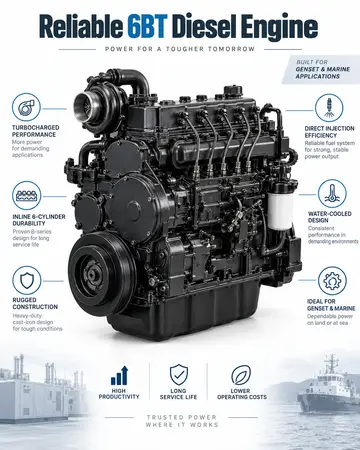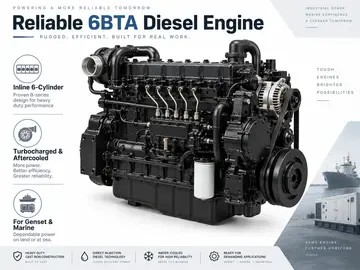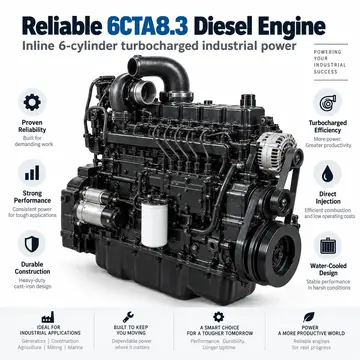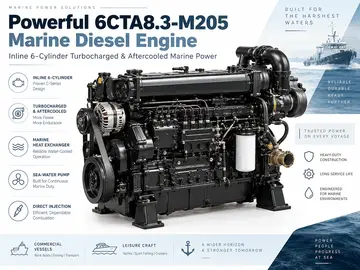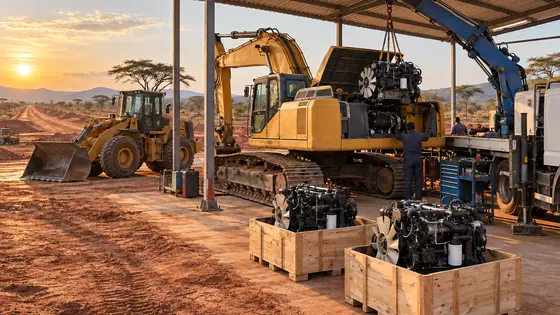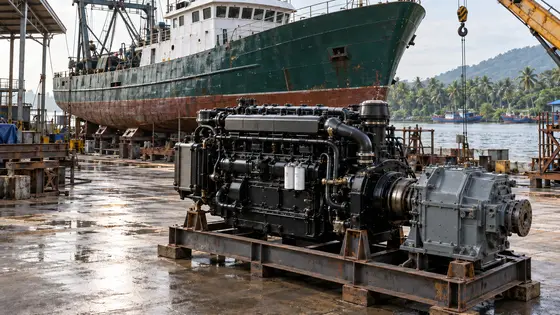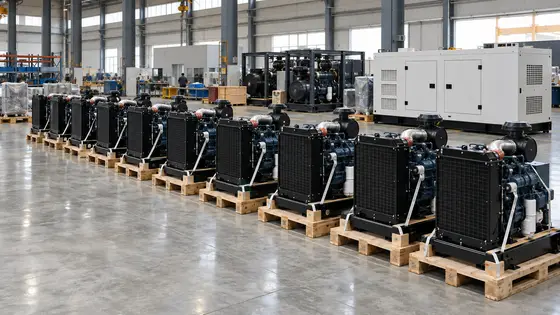
The 6BT and the 6CTA8.3 are both inline six-cylinder, four-stroke turbocharged diesels, but the 6BT is the 5.9 L B-series and the 6CTA8.3 is the 8.3 L C-series. In most cases the 6BT is the better fit for lighter gensets and smaller boats where weight, size and cost matter, while the 6CTA8.3 is the better fit for higher power, longer hours at load and applications where a rebuildable wet-liner block pays off over the engine's life.
Key takeaways
- The 6BT displaces 5.9 L from a 102 × 120 mm bore and stroke; the 6CTA8.3 displaces 8.3 L from a 114 × 135 mm bore and stroke.
- The "A" in 6BTA and 6CTA stands for aftercooled: the charge air is cooled after the turbocharger, which allows more power from the same displacement.
- The C-series uses replaceable wet cylinder liners, while the B-series cylinders are bored directly in the block, which makes the B-series lighter and more compact.
- For generator sets, both families run at 1500 rpm for 50 Hz or 1800 rpm for 60 Hz with a four-pole alternator.
- Power ratings overlap between the two families, so choose on duty cycle, load factor and installation space, not headline power alone.
- Always compare engines on the same rating (standby, prime or continuous for gensets; the marine duty rating for boats).
What is the difference between the 6BT and the 6CTA8.3?
Both engines come from the same design tradition and share a straightforward layout: inline six cylinders, direct injection, mechanical fuel injection on the classic versions, and a turbocharger. The difference lies in size and construction. The B-series 5.9 L is compact and light for its output. The C-series 8.3 L has larger bores and a longer stroke, and its wet liners can be replaced during overhaul without reboring the block.
| Item | 6BT / 6BTA (B-series) | 6CTA8.3 (C-series) |
|---|---|---|
| Configuration | Inline 6, 4-stroke, direct injection | Inline 6, 4-stroke, direct injection |
| Displacement | 5.9 L | 8.3 L |
| Bore × stroke | 102 × 120 mm | 114 × 135 mm |
| Air handling | 6BT turbocharged; 6BTA turbocharged and aftercooled | Turbocharged and aftercooled |
| Cylinder construction | Parent bore (no replaceable liners) | Replaceable wet liners |
| Size and weight | Smaller and lighter | Larger and heavier |
| Typical fit | Smaller gensets, light workboats, pumps | Mid-size gensets, yachts, workboats, pumps |
Exact power, weight and dimensions depend on the specific rating and build, so treat the data sheet for the exact model as the reference. For example, the 6BTA in the range is listed at 92 kW at 2800 rpm, while the marine 6CTA8.3-M205 is listed at 151 kW at 2328 rpm.
Which engine is better for a diesel generator set?
For gensets, the question is how much power you need at 1500 or 1800 rpm, and for how many hours at what load. As a rough guide, the B-series 5.9 L generally covers the lower part of the 100–200 kW class of gensets and below, while the C-series 8.3 L generally covers the upper part of that class. The boundary depends on rating and aftercooling, so confirm with the engine's G-drive data sheet.
Choose the 6BT or 6BTA when:
- The genset is a smaller standby or rental unit where the engine runs at moderate load for limited hours.
- Canopy size, weight on a trailer or container fit is tight.
- The buyer wants the lowest purchase price in its power class.
Choose the 6CTA8.3 when:
- The genset delivers prime power for long hours at a high load factor, for example on construction sites or off-grid.
- The required output sits near the top of what the B-series offers; running a larger engine at a lower share of its rating usually extends service life.
- Overhaul cost over the life of the unit matters, since wet liners can be replaced in the field.
When sizing, remember that engine output is mechanical power (kWm) and genset output is electrical (kWe). Alternator efficiency reduces kWe below kWm, and kVA equals kWe divided by the power factor, which is commonly 0.8 for rated genset output. Mismatching these units is one of the most common sizing errors.
How did a genset assembler use both engines?
A generator-set assembler in the Middle East built standby and prime-power units for rental fleets and construction sites, and ordered both families in 1500 rpm G-drive configuration: 20 units of 6BT and 15 units of 6CTA8.3, supplied with radiators, control panels and SAE 3 or SAE 2 flywheel housings. Using two engine families let the assembler cover a wider power range with a small spares list. Details are in the genset assembler case study.
Which engine is better for a marine application?
In boats, the same logic applies with one addition: the marine duty rating. A B-series 5.9 L suits lighter boats, auxiliary or harbor duty and applications where installation space is tight. A C-series 8.3 L suits heavier displacement hulls, longer hours at load and yachts or workboats needing roughly 150–250 kW per engine, depending on rating.
The C-series design also underpins other 8.3 L marine engines. The SDEC D683 (6CTA8.3-M220) shares the 114 × 135 mm bore and stroke and is offered from 250 to 360 hp at 2200 rpm, which gives operators a heavier-power option in the same size class.
On a 22 m motor yacht repower, twin 6CTA8.3-M205 engines were paired with Advance 300 gearboxes so the new engines fit the existing beds and shaft lines, with ratios close to the originals so the propellers could be kept. The owner's priority was lower noise and stable temperatures at cruise, which suited a larger-displacement engine working below its limit.
| Application | Usually the better fit | Main reason |
|---|---|---|
| Small standby genset, limited hours | 6BT / 6BTA | Lower weight, cost and footprint |
| Prime-power genset, high load factor | 6CTA8.3 | More displacement, rebuildable wet liners |
| Rental genset that must fit a compact canopy | 6BT / 6BTA | Smaller package |
| Motor yacht around 150 kW per engine | 6CTA8.3-M205 | Power at cruise with margin |
| Light workboat or harbor launch | 6BT / 6BTA | Weight and space |
| Heavy workboat, long hours at load | 6CTA8.3 or D683 | Heavier-duty 8.3 L platform |
| Fire or irrigation pump set | Either, by required power | Match rpm and power curve to the pump |
What should I check before buying either engine?
Both families are widely built and widely supported, so parts availability is generally good in most markets. Before ordering, confirm:
- The exact model and rating, such as 6BT, 6BTA, 6CTA8.3-G or 6CTA8.3-M, because ratings differ more than the family name suggests.
- Speed and frequency for gensets (1500 rpm for 50 Hz, 1800 rpm for 60 Hz) or rated rpm for marine use.
- Flywheel and flywheel housing SAE sizes to match the alternator or gearbox.
- Cooling package: radiator for gensets; heat exchanger or keel cooling for marine engines.
- Emission requirements in the destination market; several of the versions listed here are Euro 2 class, which may not be accepted everywhere.
- Test and documentation: a written test report and video before shipment help verify the engine you receive.
MARS supplies both families for genset and marine use, runs each engine before dispatch and packs for export FOB or CIF from Shanghai. For batch genset supply or a marine engine and gearbox package, send your requirements.
Frequently asked questions
Is the 6BT the same as the 6BTA?
They share the 5.9 L block, but the 6BTA adds an aftercooler that cools the turbocharged intake air, allowing higher power output. Check which version your application needs before ordering.
Can a 6CTA8.3 replace a 6BT in the same genset frame?
Not directly. The 6CTA8.3 is larger and heavier, so the frame, mounts, radiator and coupling usually need to change. It is simpler to design the genset around the chosen engine from the start.
Why does the C-series last longer under heavy load?
The larger displacement gives more power margin at a given output, and replaceable wet liners allow the cylinders to be renewed at overhaul. Actual life depends on load, maintenance and fuel quality.
What rpm do these engines run at in a generator set?
They run at 1500 rpm for 50 Hz or 1800 rpm for 60 Hz output with a four-pole alternator. The engine must be ordered in the matching G-drive configuration.
Are 6BT and 6CTA8.3 spare parts easy to find?
In most markets, yes, because both families are widely used in gensets, vehicles, pumps and boats. Confirm part numbers against the engine serial number when ordering.