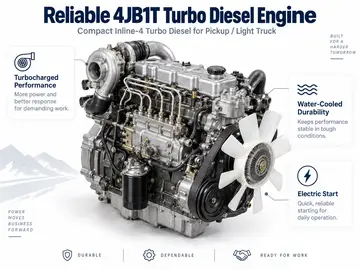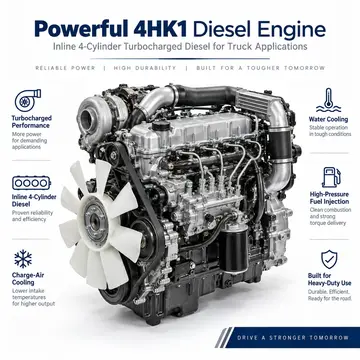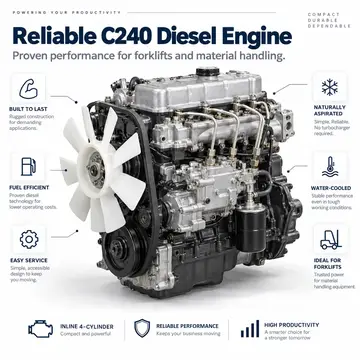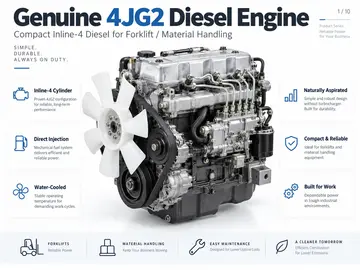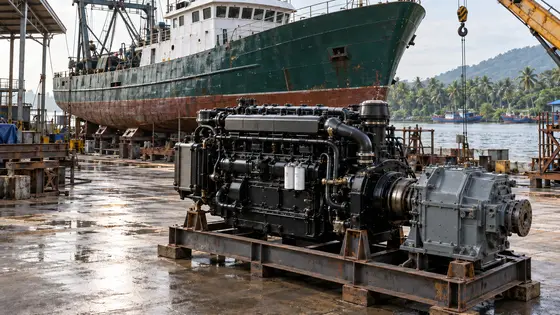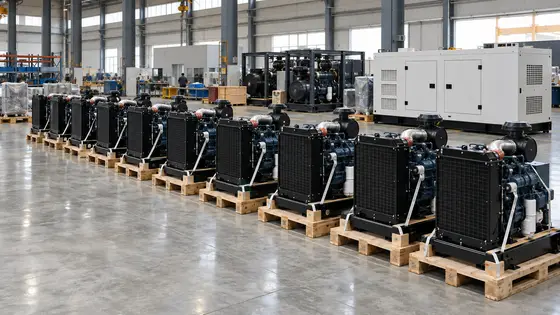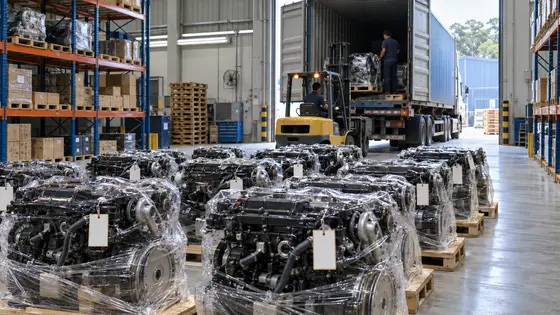
To choose the right replacement engine for a light truck, pickup or forklift, start from the old engine's model code and serial number stamped on the block. Then match the aspiration (naturally aspirated or turbo), the emission level and fuel system, the flywheel and bell housing, and the accessories the vehicle expects. The 4JB1/4JB1T, 4HK1, C240, 4JG2 and JMC JE493 look similar from a distance but are not interchangeable without work, so photos of the nameplate and the engine from all sides are the fastest route to a correct quote.
Key takeaways
- The 4JB1 is a 2.771 L inline-4 with a 93 × 102 mm bore and stroke. The 4JB1T is the turbocharged version and is commonly rated around 68 kW at 3,600 rpm.
- The JMC JE493 / JX493 family is based on the 4JB1T. Jiangling's engine plant began by building the Isuzu 4JB 2.8 L turbodiesel under license.
- The 4HK1 is a larger 5.19 L turbocharged, intercooled four-cylinder for medium-duty trucks. Emission-compliant versions generally need their matching ECU and wiring.
- The C240 (2.369 L) and 4JG2 (3.059 L) are naturally aspirated industrial engines that are widely used in diesel forklifts.
- On Isuzu industrial engines, the serial number is stamped on the cylinder block. Its location varies by model, viewed from the flywheel end.
Which engine does my vehicle or forklift actually have?
Do not rely on the vehicle model alone. The same truck or forklift model may have been built with different engines depending on market and year. Instead, collect three things before you ask for a quote:
- Engine model code. This is usually cast or printed on a plate or label, for example 4JB1, 4JB1T, 4HK1-TC, C240PKJ or JE493ZLQ3. The suffix letters often indicate the application, the fuel system or the emission version.
- Engine serial number. Isuzu's guide for industrial engines places it on the upper left rear of the block on 4J-series engines such as the 4JB1 and 4JG2. On the C240 it is on the upper left front, and on the 4HK1 it is on the lower right center of the block. All positions are viewed from the flywheel end. Chinese-built derivatives may use a different location or format.
- Vehicle or machine nameplate. Chassis VIN, forklift model and serial number, and year of manufacture.
Clear photos of the engine from the front, both sides and the flywheel end usually show the turbo, pump, mounts and bell housing well enough to confirm a match.
How do the 4JB1, 4JB1T, 4HK1, C240, 4JG2 and JE493 compare?
The figures below are typical values taken from manufacturer and product data sheets. Ratings vary with application and emission version, so always confirm against the data sheet for your exact model.
| Engine | Displacement | Aspiration | Typical rating | Main applications |
|---|---|---|---|---|
| 4JB1 | 2.771 L | Naturally aspirated | ~57 kW @ 3,600 rpm (varies) | Pickups, light trucks, machinery |
| 4JB1T | 2.771 L | Turbocharged | ~68 kW @ 3,600 rpm | Pickups, light trucks |
| JMC JE493 | 2.771 L | Turbocharged | ~68 kW @ 3,600 rpm | JMC light trucks, pickups, vans |
| 4HK1 | 5.19 L | Turbo, intercooled | Varies by version | Medium-duty trucks, machinery |
| C240 | 2.369 L | Naturally aspirated | ~35 kW @ 2,500 rpm | Forklifts, industrial |
| 4JG2 | 3.059 L | Naturally aspirated | ~46 kW @ 2,450 rpm | Forklifts, industrial |
What should I check on a 4JB1 or 4JB1T for a pickup or light truck?
The 4JB1 family is probably the most common light-duty diesel in many aftermarket markets, so both new and rebuilt units are easy to find. The main risk is ordering the wrong variant.
- Naturally aspirated or turbo. A 4JB1T needs the matching turbo, intake and exhaust manifolds, oil feed and return lines, and often a different injection pump setting. Converting an NA vehicle to turbo is not a simple bolt-on job.
- Injection pump and throttle linkage. Mechanical pumps differ in governor type and linkage position between truck, pickup and industrial versions.
- Accessories. Confirm whether you need the alternator, starter, power-steering pump, A/C compressor bracket, fan and water pump, or only a long block. The 4JB1 / 4JB1T engine can be supplied either way.
- Flywheel and clutch. Check the flywheel diameter and clutch size against the gearbox.
For JMC trucks, the JE493 (4JB1T-based) is usually the most direct fit. Many internal parts cross-reference to the 4JB1, but the brackets, sensors and wiring follow the JMC vehicle. The later emission versions of JMC engines in most cases use electronically controlled fuel systems, so the suffix of the old engine's model code matters.
When is a 4HK1 the right choice, and what is different?
The 4HK1 sits a class above the 4JB1. At 5.19 L, with turbocharging and intercooling, it is used in medium-duty trucks and some construction machines. Most versions built for Euro 3 and above are electronically controlled with common-rail injection. A replacement therefore usually needs the matching ECU, wiring harness and sensors, and the ECU software has to suit the vehicle.
Before ordering, confirm the emission level (for example Euro 3, Euro 4 or China equivalents), whether the vehicle has an exhaust aftertreatment system, and whether the old ECU will be reused. Mixing an engine and ECU from different emission versions is a common cause of fault codes and poor running.
What should I check on C240 and 4JG2 forklift engines?
The C240 and 4JG2 are simple, naturally aspirated industrial engines that are widely used in diesel forklifts from several manufacturers. The C240 usually appears in smaller-capacity trucks. The 4JG2 has more displacement and output and is common in mid-capacity trucks. Forklift installations differ from vehicle installations in several ways:
- Bell housing and torque converter. Most diesel forklifts use a powershift transmission. The flywheel, flex plate and housing must match the forklift make.
- Fan direction and radiator position. Forklifts often use a pusher fan (blowing air out through the radiator), which differs from vehicle-type suction fans.
- Governor setting and rated speed. Industrial engines run governed speeds, and the injection pump must be set for forklift duty.
- Mounting feet and sump shape. These vary with the chassis, so compare the old engine side by side.
- Accessories. Decide whether you are ordering a bare engine or a unit with injection pump, alternator, starter and radiator.
Our forklift fleet renewal project in Turkey is a good example: C240 and 4JG2 engines were held in reserved stock and shipped with matched accessory sets on call-off.
How should I order a mix of variants for a distributor or fleet?
Distributors often need NA and turbo versions, complete engines and long blocks in the same shipment. Ask for a specification sheet per variant, individual engine numbering and a label on each crate showing the model code. That makes warehouse picking and warranty tracking simple. In our light-truck engine programme in the Philippines, 4JB1T, 4JB1, JE493 and long-block units were loaded as mixed containers with per-variant labelling.
MARS typically supplies stock engines promptly. Each unit is run-tested before dispatch, with a written report and video, and warranty terms are confirmed per product. Send your nameplate photos through the contact page for a variant check.
Frequently asked questions
Can a 4JB1T replace a 4JB1 directly?
It fits the same basic block dimensions, but it needs the turbocharger, matching manifolds, oil lines and often a different pump setting and exhaust routing. Treat it as a conversion, not a direct swap.
Is the JMC JE493 the same as an Isuzu 4JB1T?
The JE493 is a 4JB1T-based engine built by JMC, so displacement, bore and stroke match and many internal parts cross-reference. Brackets, sensors and emission-related parts can differ, so match against the old engine's model code.
Where is the serial number on a C240 or 4JG2?
According to Isuzu's industrial engine guide, it is on the upper left front of the block on the C240 and the upper left rear on 4J-series engines such as the 4JG2, viewed from the flywheel end.
Do I need a new ECU with a replacement 4HK1?
If the vehicle uses an electronically controlled 4HK1, the ECU, harness and software must match the engine's emission version. Many buyers order the engine and ECU together to avoid compatibility problems.
Should I buy a complete engine or a long block?
A complete engine with accessories shortens installation time and reduces the risk of reusing worn parts. A long block costs less when the existing injection pump, turbo and accessories are in good condition.